The Market for AI Governance Platforms: The $12.5bn Control Plane

That gap is the central finding of our new Special Report, AI Governance Platforms, and it is reshaping where enterprises spend.
The evidence is stark. AIMG estimates that 96.5% of large US public companies have a formal AI governance policy, yet 46.3% of their senior AI executives admit governance has been bypassed for urgent deployments. 98.2% of organizations maintain AI data-access policies, yet 85.7% of IT leaders have seen an AI tool or agent reach sensitive data outside its intended scope in the past year. Policy coverage is near-universal; operational control is not.
A bigger market than the narrow definition suggests
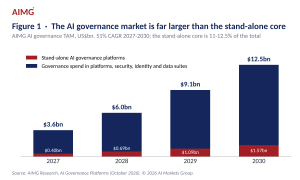
Measured narrowly, stand-alone AI governance platforms are a $0.40bn market in 2027, rising to $1.57bn by 2030. That number misses most of the spend, because enterprises increasingly govern AI through hyperscaler platforms, AI security gateways, identity suites and data-governance tools. Counting that governance-specific spend, AIMG sizes the addressable market at $3.6bn in 2027, growing to $12.5bn by 2030, a 51% compound rate. The stand-alone core is only 11-12.5% of it.
Agents change the problem
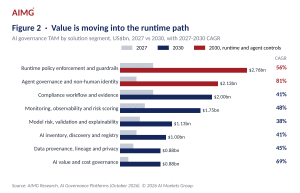
As AI shifts from assistants that answer to agents that act, a governance failure is no longer a bad answer but an unauthorized action. Agent governance and non-human identity is the fastest-growing segment at 81% a year, and runtime policy enforcement and guardrails becomes the largest segment by 2030 at $2.76bn. Compliance workflow, the segment that created the category, remains essential but loses share as value moves into the runtime path.
Regulation sets the timing
The EU Digital Omnibus on AI, which amended the EU AI Act in July 2026, moved the high-risk deadlines to December 2027 and August 2028 but did not remove them. Deferral is not relief: conformity evidence cannot be reconstructed retrospectively. In the US, fragmentation between federal preemption and state statutes raises the value of multi-jurisdiction policy content. Europe holds 28% of the 2027 market; Asia-Pacific grows fastest at 59% a year.
Consolidation is coming
Securing AI and governing it are becoming one control problem, and identity is the most contested control point. Deal flow has already begun, including SentinelOne-Prompt Security, Zscaler-SPLX, SailPoint-Entro and ServiceNow-Veza, and AIMG expects most of today’s stand-alone specialists to be acquired or merged by 2028. The AI LeaderMap® tells the same story: the Frontier and Sustainable corner is held by platforms and security vendors whose governance capability is embedded rather than stand-alone, while the independent specialists cluster in the Adaptive band, with Credo AI the exception on innovation.
What it means
For buyers, the priority is one AI inventory and approval flow, wired to runtime guardrails and agent identity for the highest-risk use cases, before the 2027 deadlines rather than after. For vendors, the imperative is to be the place where policy becomes a runtime decision. For investors, value will migrate toward owners of runtime control, agent identity and audit-grade evidence, and away from questionnaire-led compliance tooling.
AI governance is turning from a committee and a spreadsheet into a control plane. The vendors that own the enforcement points will capture most of the value.
Source: AI Governance Platforms Report by AIMG