How Enterprise AI Leaders Are Using M&A as a Competitive Advantage

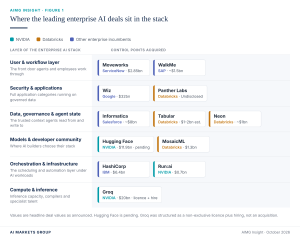
In enterprise AI, the companies pulling ahead are not mainly buying revenue. They are buying control points: layers of the stack, standards, developer communities and workflows they cannot build fast enough themselves and that, once owned, make everything else they sell more valuable. For some of them, M&A has become a faster route to market than R&D.
Databricks: M&A to enter new categories
About ten acquisitions since 2023, led by MosaicML, Tabular and Neon, have turned a data engineering platform into an enterprise AI operating layer. Each deal extends Unity Catalog, so every new workload inherits the same governance. Investors now value Databricks at $190bn, roughly 27x EV/ARR.
NVIDIA: M&A plus capital to shape demand
Ten deals worth roughly $34bn since February 2024, over 90% of it in Groq and the pending Hugging Face deal, secure inference capability and the front door for open-source developers, while a $99bn equity portfolio ties customers and suppliers to CUDA. Salesforce, ServiceNow, IBM, SAP and Google are buying the layers AI agents depend on in the same way.
Why M&A can beat R&D to market
In AI the build-versus-buy trade-off has tilted, because the market moves faster than an internal roadmap. Four reasons stand out.
The product-market fit test has already been passed. An internal build starts with a hypothesis; an acquisition can start with proof. When Databricks agreed to buy Neon, over 80% of the databases created on Neon were being provisioned by AI agents, up from around 30% a year earlier. Wiz brought Google roughly $700m of ARR. Moveworks brought ServiceNow more than 350 large enterprise customers, including 10% of the Fortune 500, and around 5 million employee users. The buyer pays a premium, but for demand already validated.
Acquired capability ships in weeks, not years. Databricks launched Lakebase on Neon’s technology four weeks after announcing the deal; it passed $100m ARR within about a year. NVIDIA unveiled Groq-based LPX inference racks twelve weeks after the Groq deal, and appears to have shelved its own in-house Rubin CPX design in their favour.
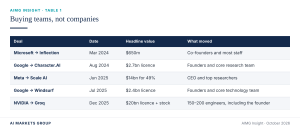
The scarce input is people, and deals move them fastest. Big Tech has spent around $20bn since March 2024 on “licence and hire” deals that transfer teams rather than companies, typically agreed in weeks.
It expands the addressable market, not just the product line. The most strategic deals bring a new buyer, workload or use case that the core product never reached. Lakebase takes Databricks into the database market, which its CEO sizes at $105bn. Moveworks extends ServiceNow from the IT service desk to every employee in the enterprise. Groq takes NVIDIA deeper into low-latency inference, and Wiz gives Google Cloud a security business sold into AWS and Azure environments. Capital is following: in 2025, nearly half of strategic tech deal value above $500m involved AI.
The product leader’s call
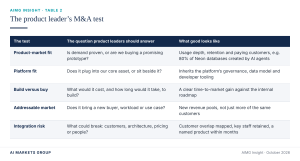
Whether a deal beats a build is ultimately a product question, which puts the Chief Product Officer and product management team at the centre of AI M&A. They are best placed to judge whether product-market fit is real, whether the target plugs into the core platform or sits beside it, and what building instead would cost in time and money. They also own the integration risk that most often erodes value: overlapping customers, clashing architectures, pricing and packaging, and retaining the engineers who made the product work. Fast results such as Lakebase are only possible when the product path is clear at signing, so product leaders belong in the deal from screening, not after close.
This is a route for some companies, not all: those with a platform to absorb deals into and the balance sheet to pay ahead of returns. The costs are real, including regulatory scrutiny, with the US Department of Justice now examining the Groq deal’s structure.
Patents: a leading indicator on a lagging clock
Patents remain a strong indicator of innovation and direction of travel: agentic AI’s share of patent activity doubled from 7% to 15%, and NVIDIA now leads in agentic AI applications. But applications typically publish around 18 months after filing and grants can take years longer, so a granted patent often protects an earlier generation of the technology. The leaders therefore run two clocks: they file where they are heading and buy where they are behind.
The AIMG view
For the leading companies, M&A has become R&D with a quicker payback: it buys proven demand, ready-made teams and new markets in one move. Patents signal where they are going; acquisitions buy the time to get there first.
The test ahead is who can turn deals into compounding platform usage, with product leaders steering integration, before the costs and regulatory scrutiny come due.