How Enterprise AI Companies Build Category Authority

AI companies are commanding a premium, but not all are creating the same value.
AIMG’s AI M&A analysis found that AI acquisitions averaged 11.6x revenue multiples, exceeding comparable public AI companies. That premium is telling.
The market is rewarding more than differentiated technology. It is rewarding companies that shape how buyers understand value, reduce uncertainty, and make confident decisions in an emerging category.
For enterprise AI companies, that creates a new commercial reality. The strongest technology does not automatically become the market leader. In emerging categories, buyers are not only evaluating what a solution can do; they are looking for companies that help them understand the opportunity, navigate complexity, and make informed decisions. That is the difference between a technology provider and a category authority.
Category authorities shape the conversation before the buying process begins. They influence how the market thinks about the problem, what outcomes matter, and why a particular approach deserves consideration.
The goal is not simply market recognition. It is becoming the company buyers trust to navigate a critical new business decision.
The AI Age Requires a New Buyer Mental Model
Enterprise technology buyers have traditionally relied on familiar evaluation models built around defined categories, established criteria, and predictable buying processes.
Enterprise AI decisions are different. Buyers still evaluate vendors through familiar criteria: capabilities, features, pricing, implementation requirements, and competitive comparisons. That framework was built for established categories where the problem is understood and the criteria are clear.
AI is different because the category itself is still being defined. Buyers are not just comparing what a solution can do; they are trying to determine whether it will work in their environment, whether the company behind it will remain relevant as the market evolves, and what happens if they make the wrong decision.
The challenge is not a features gap. It is an evaluation gap.
The decision is no longer about which company checks the most boxes. It is about which company helps buyers make sense of uncertainty.
Decision Confidence Requires a New Buyer Framework
Enterprise AI decisions are not made by a single buyer. They are evaluated across a matrix of stakeholders, each assessing a different dimension of value, risk, and accountability.
The CEO is evaluating strategic impact and competitive implications. The leadership team is focused on business outcomes and operational advantage. The CTO is assessing scalability, architecture, integration, and future capabilities. Risk and Governance teams are evaluating security, compliance, and responsible adoption. Finance is measuring economic impact, investment tradeoffs, and long-term value.
The challenge is not that buyers lack information. It is that each stakeholder is looking for different evidence to support the same decision. Because each stakeholder needs different proof, category leaders cannot rely on traditional marketing alone. They need a way to turn market signals, alliance credibility, and customer behavior into evidence buyers can trust.
For example, buyers lean on trusted partners and networks to determine which companies are worth considering. AIMG’s Enterprise AI 2026 Benchmark Study illustrates this shift. At the platform level, LLM adoption is increasingly shaped by distribution partnerships, such as Microsoft’s integration of Anthropic’s Claude models through Azure, rather than by direct vendor selection.
For companies in developing categories, this means credibility must be built intentionally through alliances, partner programs, and adjacent networks. The strongest emerging category leaders also capture proprietary market and client signals to create an intelligence layer that combines buyer questions, alliance signals, product usage patterns, workflow adoption, and operating model changes. Those signals reveal how the market is evolving, where uncertainty remains, and what evidence will help buyers move forward with confidence.
EXAMPLE: How Category Leaders Build Decision Confidence
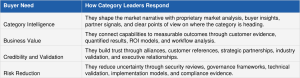
How Category Authority Is Built
Shaping the decision environment is the new commercial imperative for AI companies. It requires moving beyond traditional go-to-market motions focused on awareness, activity, and volume toward an approach built around how buyers evaluate, prioritize, and make decisions.
Category leaders align their market, product, sales, and partner motions around the signals that matter most to buyers. This changes how the organization operates. Rather than creating disconnected marketing, sales, product, customer, and alliance initiatives, category leaders coordinate around the moments that influence the buyer decision journey.

The pivot is from creating more market activity to creating more precision. Category leaders use buyer signals to understand where uncertainty exists, shape the right conversations, and deliver the perspective, education, and validation required to influence decisions.
That is how companies move from participating in a category to shaping it.
Conclusion
The companies that win in enterprise AI will not be the ones with the loudest message or the most advanced model.
They will be the ones that help buyers make sense of uncertainty, build confidence across stakeholders, and move from consideration to conviction.