From Knowledge Graphs to Context Graphs

However, as AI systems evolve from passive analytical tools into autonomous agents, the limitations of traditional knowledge graphs are becoming increasingly apparent.
A new architectural model is emerging: the context graph.
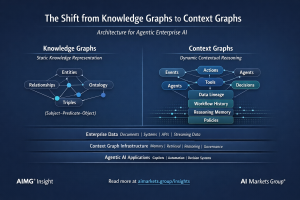
Context graphs extend traditional graph structures beyond static representations of “what exists” to capture how work actually happens inside organisations – including actions, decisions, processes, and temporal relationships. This shift reflects a deeper transformation in enterprise AI: from systems that answer questions to systems that execute tasks and make decisions.
The Limits of Static Knowledge Graphs
Traditional knowledge graphs were designed primarily to encode structured knowledge about entities and relationships. Their core architecture revolves around relatively stable ontologies and predefined schemas.
While this structure works well for representing facts, it struggles to capture the dynamic, evolving nature of real organisational activity.
Enterprise environments are characterised by:
- Continuous workflows
- Multi-step decision processes
- Interactions between humans, software tools, and automated agents
- Changing contexts across time
Static graphs model relationships, but they often fail to capture process and causality.
This limitation creates what can be described as the “static graph fallacy” – the assumption that complex organisational behaviour can be adequately represented through fixed relationships between entities.
As AI systems begin executing workflows and making operational decisions, this assumption breaks down.
Agentic AI and the Need for Context
The emergence of agentic AI systems is a primary driver behind the transition toward context graphs.
Unlike traditional AI models that respond to prompts or queries, agentic systems are designed to:
- perceive environments
- plan multi-step actions
- interact with tools and software systems
- learn from outcomes
Industry research increasingly suggests that autonomous AI agents will power a significant share of enterprise applications over the coming years. As these systems take on more operational responsibility, they require architectures capable of tracking actions, decisions, and reasoning over time.
This is where context graphs become critical.
Rather than storing only entities and relationships, context graphs incorporate multiple additional dimensions, including:
- decision traces
- workflow steps
- temporal validity
- data lineage
- tool usage history
The result is a living representation of organisational activity rather than a static knowledge map.
Reasoning Memory: The Defining Feature
The most important architectural feature of context graphs is what can be described as reasoning memory.
Reasoning memory records the step-by-step logic an AI system used to reach a decision. It captures:
- intermediate reasoning steps
- tool invocations
- data sources consulted
- branching decision paths
- final outcomes
This capability provides several critical benefits.
First, it enables explainability. AI systems can reconstruct how decisions were made, allowing organisations to audit automated actions.
Second, it enables learning from experience. Systems can analyse past decision paths, identify errors, and optimise future strategies.
Third, it enables long-horizon reasoning, allowing AI agents to manage workflows that extend across days, weeks, or even months.
In practice, context graphs operate across multiple layers of memory:
Working memory maintains the active reasoning state during a task.
Long-term memory preserves semantic knowledge and historical events across sessions.
Procedural or reasoning memory records the decision logic and execution traces that define how tasks were completed.
Together, these layers form the operational backbone required for persistent AI agents.
Compliance, Governance and Traceability
Another major driver of context graph adoption is the growing regulatory focus on AI transparency and accountability.
Regulatory frameworks such as the EU AI Act increasingly require organisations to demonstrate how automated decisions are produced. Compliance frameworks demand documentation of:
- training data sources
- decision logic
- model outputs
- operational controls
Traditional AI architectures often struggle to provide this level of traceability.
Context graphs, by contrast, inherently capture the entire decision chain, including data lineage, policy enforcement, and runtime reasoning.
This capability shifts AI governance from a “trust us” model to a “show me” model, where organisations can provide verifiable evidence of how automated decisions were generated.
In regulated industries such as finance and healthcare, this traceability may become a critical requirement for deploying autonomous systems at scale.
Capturing Institutional Knowledge
A further benefit of context graphs is their ability to capture institutional knowledge.
In most organisations, a significant share of operational expertise exists as undocumented “tribal knowledge” held by individual employees. When employees leave, this knowledge often disappears with them.
Context graphs address this challenge by continuously ingesting signals from operational activity, including:
- system updates
- workflow approvals
- collaboration activity
- decision outcomes
Over time, this creates a living knowledge repository reflecting how work is actually executed.
For AI systems, this repository provides a contextual foundation for decision-making that reflects real organisational behaviour, not just abstract rules.
The Emerging Vendor Landscape
The shift toward context-aware AI architectures is reshaping the enterprise software landscape.
Vendors that historically focused on discrete analytics tools or standalone data platforms are increasingly re-architecting their systems around persistent memory and contextual reasoning.
The emerging ecosystem includes several categories of providers:
Graph database innovators
These vendors provide the foundational infrastructure for managing highly connected datasets and reasoning paths.
Enterprise search and context engineering platforms
These solutions integrate structured and unstructured information to provide contextual retrieval for AI systems.
Ontology and semantic modelling platforms
These tools enable organisations to define structured representations of enterprise knowledge.
Unified data and AI platforms
Large technology platforms are increasingly incorporating graph and memory capabilities into broader AI infrastructure stacks.
Together, these technologies form the architectural foundation required for persistent, autonomous enterprise AI systems.
A Structural Shift in Enterprise AI
The transition from knowledge graphs to context graphs represents more than a technical refinement.
It reflects a deeper shift in the role of AI within organisations.
Earlier generations of enterprise AI were primarily designed to analyse information.
The next generation will increasingly be designed to act on it.
To support this transition, AI systems require architectures that capture not only data and relationships but also actions, decisions, and reasoning processes.
Context graphs provide the structural foundation for this capability.
As enterprise AI continues to evolve toward autonomous systems, context management may become one of the most important layers of the AI technology stack.
AIMG® Insight
For enterprise leaders, the key implication is clear: the competitive advantage of AI systems will increasingly depend not only on models, but on the quality of contextual memory and reasoning infrastructure surrounding those models.
Organisations that invest early in architectures capable of capturing and operationalising context will be better positioned to deploy AI agents that are explainable, auditable, and capable of operating reliably inside complex enterprise environments.
In this sense, the emergence of context graphs may represent one of the most important structural shifts in enterprise AI architecture since the rise of knowledge graphs themselves.
Source: AIMG Research