AI sovereignty: the new industrial border

From markets to power
AI has shifted from commercial tool to instrument of state capacity, with implications for productivity, defence and geopolitical leverage. AIMG analysis shows sovereignty is now a contest over three scarce assets: data, compute and skills.
The sharpest rivalry is between America and China. China is using state-backed AI deployment to support industrial upgrading and self-sufficiency, while America is pursuing scale, speed and technological leadership through a more permissive model. Other countries, including South Korea, Canada, Japan and India, are also investing in local models and domestic compute to reduce dependence on foreign platforms.
Law shapes the market
AIMG views Europe as the clearest example of AI regulation as industrial policy. The EU AI Act applies risk tiers, bans some uses and allows penalties of up to €35m or 7% of global turnover, while also reaching firms whose outputs are used in Europe.
AIMG views America as more innovation-first, though fragmented by state-level rulemaking, while Singapore occupies a more agile middle ground built on voluntary governance and testing tools. For firms, this means AI sovereignty is shaped as much by legal architecture as by technical capability.
The return of geography
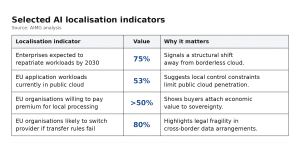
AIMG research suggests that borderless cloud is giving way to data localisation. Up to 75% of global enterprises are expected to repatriate some workloads to local or regional platforms by 2030.
In Europe, sovereignty concerns are already affecting purchasing behaviour. Data sovereignty is a top-three issue for cloud customers; only 53% of application workloads currently run in the public cloud in the EU; more than half of surveyed organisations would pay a premium for European storage and processing; and 80% would move to a European provider if EU-US transfer arrangements failed.
For highly regulated sectors, even localisation may be insufficient. AIMG analysis points to growing use of air-gapped AI systems in defence, government and other sensitive environments where keeping data off the public internet is itself a sovereign requirement.
The price of autonomy
Sovereignty is costly. AIMG analysis shows a “digital sovereignty trilemma” in which firms trade off control, cost and performance as they move to dedicated sovereign platforms. Nearly 47% of organisations are over-provisioning infrastructure for resilience and compliance, and average cloud waste in EMEA is estimated at €900K per enterprise each year.
The hardest constraint may be talent rather than hardware. AIMG analysis finds a “productivity paradox”: institutions are investing in AI faster than they can build the workforce needed to govern and deploy it effectively. Nearly one in four technology professionals globally have quit because employers did not provide enough AI upskilling, while rising American pay increases the risk of global brain drain.
A fragmented future
AIMG research points to a world of parallel AI ecosystems in which data residency, local regulation and national security matter more than frictionless global deployment. Multinationals will need region-specific architectures and duplicated compliance capabilities, while governments must pursue resilience without allowing sovereignty to become an excuse for inefficiency or isolation.
AI sovereignty, then, is not just about control. It is about deciding which dependencies are too risky to keep, and which are still efficient enough to tolerate.
Source: AIMG Research