$97B by 2027: The G7’s Race to Lead the Global AI Economy

The G7 enterprise AI software market is on the brink of a profound transformation, with market forces and national ambitions converging to make AI software the new battleground for global economic influence. The coming years will not only redefine the competitive landscape at the company level, but also at the national level as governments, investors, and enterprises race to set the pace—and the rules—of artificial intelligence adoption.
The New Core Infrastructure
Across the G7, the enterprise AI software market is anticipated to expand from $57 billion in 2025 to nearly $97 billion by 2027, marking a commanding 31% compound annual growth rate. The United States leads by sheer scale, growing from $34 billion to $58 billion, setting the benchmark that others chase. Yet, leadership across the G7 is nuanced: Germany stands out for industrial adoption, surging from $9 billion to $15 billion, while Japan’s standout 65% growth in generative AI marks it as a technological vanguard. The UK and Canada are set to post the fastest relative growth, and Italy along with France is rapidly closing the gap through targeted digital transformation and state-driven investments.
Market Contours and Competitive DNA
Each G7 nation maps its own AI strategy onto familiar competitive terrain. Financial services remain the dominant sector in the US and UK, manufacturing is king in Germany and Italy, while Japan and Canada’s AI ambitions are tied to IT and telecoms. France offers perhaps the most balanced sectoral adoption. On the technology side, machine learning platforms currently dominate most markets, but the fastest growth stories are reserved for generative AI in the UK, Italy, Canada, and Japan—reflecting both local innovation and a global appetite for transformative solutions.
The Investment and Policy Imperative
For global investors, executives, and policymakers, the message could not be clearer: AI software is now core digital infrastructure, as central to competitive advantage as the cloud was a decade ago. The G7’s evolving AI market landscape will not only shape balance sheets, but also national economic resilience and sovereignty. Competitive advantage will increasingly depend on how effectively countries as well as corporations cultivate AI capabilities—and how boldly they move from experimentation to enterprise-wide deployment.
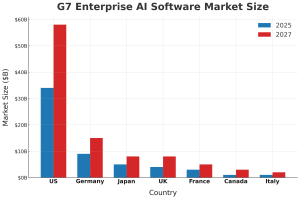
Source: AIMG TAM Analysis
AI is reconfiguring the economic equation in the world’s most advanced economies, and the stakes for getting it right have never been higher. The G7’s choices now will echo far beyond 2027, setting the contours of economic and technological leadership for years to come.